Friday, July 12, 2019

Leukaemia Blood cancer Treatment  India

About Leukaemia Cancer

Leukaemia is a cancer of blood cells. It begins in the bone marrow which are the soft tissues inside the bones. Most often, it is a cancer of white blood cells but some leukaemia start in other blood cells types. It produces abnormal white blood cells called leukaemia cells. These abnormal blood cells grow faster than normal blood cells and do not stop when they are supposed to.
There are several types of Leukaemia. In general, Leukaemia can be grouped into two broad categories:
  • Acute or Chronic: Acute Leukaemia gets worse in a short time period and may make you feel sick right away. Chronic Leukaemia gets worse slowly and may not cause symptoms for years.
  • Lymphocytic or Myelogenous: Lymphocytic leukaemia affects white blood cells. Myelogenous leukaemia affects white blood cells called myelocytes.
Types of Leukaemia include:
  • Acute Lymphoblastic Leukaemia (ALL)
  • Acute Myelogenous Leukaemia (AML)
  • Chronic Lymphocytic Leukaemia ( CLL)
  • Chronic Myelogenous Leukaemia (CML)

Causes of Leukaemia

The exact cause of leukaemia is still not known, however there are few risk factors which increase the risk of certain kinds of leukaemia. These include:
  • Certain genetic disorders like down syndrome are associated with increased risk of leukemia.
  • People exposed to high level of radiations . Nuclear reactor, for instance.
  • Certain Chemical Exposure like Benzene.
  • Viral Infections.
  • Smoking and tobacco use is associated with acute myelogenous leukemia.
  • People with medical conditions like Pneumonia, sinusitis, chronic osteoarthritis etc. have a slightly higher risk of developing leukemia.
  • Family history.

Symptoms:

Common Symptoms of acute or chronic leukaemia may include:
  • Swelling and pain on the left side of the abdomen
  • Swollen lymph nodes that usually don't hurt
  • Frequent bleeding from the gums or rectum and heavy menstrual bleeding
  • Feeling Weak or tired
  • Weight Loss or loss of appetite for no known reason
  • Fever or Night Sweats
  • Bone pain

Leukaemia Blood cancer Treatment India

Thursday, July 11, 2019

Gastric Bypass Surgery in India

What is Gastric Bypass ?

Gastric bypass surgery is a type of Bariatric surgery. The procedure of gastric bypass surgery has been specifically designed for reducing the food intake for those who have failed to reduce their weight by every means. The purpose of the procedure is to make changes in the digestive system so as to limit the consumption of food. The procedure can improve the overall quality of life not only in terms of appearance but also reduce a number of health problems that overweight people are prone to suffer like heart problems and diabetes.

Types of Gastric Bypass Surgery

Biliopancreatic Diversion Bypass : This technique is less common and where the bypass is attached to the distal illium and the portion of the stomach is removed.
Roux-en-Y Gastric Bypass : This technique is more common than Biliopancreatic diversion bypass.  Roux-en-Y technique does not remove any portions of the stomach. The technique is performed with the help of open surgery by making 1 long incision. The technique can also be done laparoscopically and multiple smaller incisions are used instead of one long incision. The surgeon inserts a laparoscopic instrument in order to view the abdomen from within.

Who should consider Gastric Bypass Surgery ?

  • Candidates who have a BMI (Body Mass Index) of 40 or more.
  • Candidates who weigh 100 pounds or more than their ideal body weight.
  • Candidates who have serious health problems of heart disease and diabetes due to excess weight and who have a BMI of 35 or more.

Procedure for Gastric Bypass Surgery

  • The procedure is performed under general anesthesia.
  • The procedure begins by making the stomach smaller. Staples are used for dividing the stomach into two sections- a larger bottom section and a small upper section. Pouch (top section) is that part where the food eaten is stored. This pouch can hold around one ounce of food and is of walnut shape.
  • A bypass is the next step. The small part of the small intestine is connected to a small hole in the pouch. The food will travel from this top section of the stomach (pouch) into the small intestine. Due to this entire process, the food will absorb less calories.
Gastric Bypass Surgery in India

Monday, July 8, 2019

Orthopedic Treatment in India

Orthopedic Surgery in India

Orthopedic Surgery is the branch of surgery concerned with conditions involving the musculoskeletal system. Orthopedic surgeons use both surgical and nonsurgical means to treat musculoskeletal trauma, spine diseases, sports injuries, degenerative diseases, infections, tumors, and congenital disorders.

The word Orthopedics comes from two Greek words, ortho, meaning straight and pais, meaning child. Originally, orthopedic surgeons dealt with bone deformities in children, using braces to straighten the child's bones. With the development of anesthesia and an understanding of the importance of aseptic methods in surgery, orthopedic surgeons extended their role to include surgery involving the bones and related nerves and connective tissue.

Orthopedic sometimes spelled orthopaedic surgery is surgery performed by a medical specialist, such as an orthopedist or orthopedic surgeon, trained to deal with problems that develop in the bones, joints, and ligaments of the human body.

Some of the conditions and diseases an orthopaedic surgeon treats include:

  • Abnormalities of the fingers and toes.
  • Back pain, ruptured disks, sciatica and scoliosis.
  • Bone tumors, muscular dystrophy and cerebral palsy.
  • Club foot, bunions, bow legs, knock knees and unequal leg length.
  • Fractures and dislocations.
  • Growth abnormalities.
  • Osteoarthritis.
  • Osteoporosis.
  • Rheumatoid arthritis.
  • Sports or work-related injuries.
  • Tendon injuries, pulled muscles, bursitis and torn cartilage.
  • Torn ligaments, sprains and strains.

Types of Orthopaedic Surgery Joint replacements


Joint replacement is a kind of orthopaedic surgery known for restoring freedom of movement and eliminate the pain because of degenerated and diseased joints. Hip and know replacement are the most common ones. Due to technological advancements, now-a-days cementless implants are being used for customized fitting to increase longevity. This surgery might not last long and may need a second chance too.

There are various kinds of joint replacement surgeries:

  • Total hip replacement
  • Total knee replacement
  • Total shoulder replacement
  • Total elbow replacement
  • Partial Knee Replacement
  • Wrist replacement
  • Hand joint (small) replacement surgery
  • Ankle joint replacement
  • Minimally Invasive Knee Replacement Surgery [MIKRS]
Orthopedic Treatment in India


Monday, July 1, 2019

Skin Cancer Treatment India

Overview:

Skin Cancer is a cancer that forms in the tissues of the skin. It grows uncontrollably and affects the normal function of the skin. If left unchecked it can spread to other parts of the body. Most skin cancers form in older people on parts of the body exposed to the sun or in people who have weakened immune systems. Skin cancer can occur anywhere on the body, but it is most common when the skin is often exposed to sunlight, such as the face, neck, hands, and arms.

Symptoms of Skin Cancer:

Skin cancer is often painless and each type can look different.
  • BCC often appears as a small red or pink, waxy or shiny lump.
  • SCC often appears as a small pink lump with a hard or scaly or crusty skin.
  • Melanoma usually starts as a dark spot or mole.
Symptoms that may indicate skin cancer include any mole, spot, lump or patch that:
  • doesn't heal after four weeks
  • gets bigger - especially over 7mm (a quarter of an inch) in diameter
  • changes shape - look for an irregular edge
  • changes colour - darkens, becomes patchy or multi-shaded
  • becomes inflamed
  • is itchy or painful
  • bleeds or is crusty
These symptoms aren't always caused by skin cancer but if you have them, see your GP.

Types of Skin Cancer:

Like all body tissues our skin is made up of cells: basal cells, squamous cells and melanocytes. Skin cancer types are named after the skin cell in which the cancer develops: basal cell carcinoma, squamous cell carcinoma and melanoma.

  • Melanoma: Skin cancer that forms in melanocytes (skin cells that make pigment) is called melanoma. Melanoma is the deadliest type of skin cancer.
  • Basal Cell Carcinoma: Skin cancer that forms in the lower part of the epidermis (the outer layer of the skin) is called basal cell carcinoma.
  • Squamous Cell Carcinoma: Skin cancer that forms in squamous cells (flat cells that form the surface of the skin) is called squamous cell carcinoma.
Skin Cancer Treatment India


You May Also Like:
Pediatric Trauma Surgery India
Pediatric Trauma Surgery in India:
A pediatric trauma surgery is any type of surgical procedure that deals with a traumatic injury that is suffered by an infant, child or young adolescent.


Liver Cancer Treatment in India
Liver Cancer Treatment in India:
The liver is one of the most important organs of the body as it is responsible for filtering the blood continuously for converting nutrients into necessary chemicals that are required by


What is Bone Marrow?

A part of bones called “bone marrow” create blood cells. Marrow is the soft, spongy tissue inside your bones. Bone marrow produces blood cells called “hematopoietic” stem cells. These cells will develop into many different kinds of cells. They can turn into more bone marrow cells. Or they can turn into any type of blood cell.
Certain cancers and different types of diseases keep hematopoietic stem cells from developing normally. If they’re not normal, neither are the blood cells that they make. A stem cell transplant provides you new stem cells. The new stem cells can make new, healthy blood cells. It creates the following parts of the blood.
  1. Red Blood Cells: which carry oxygen and nutrients throughout the body.
  2. White Blood Cells: which fight infection.
  3. Platelets: which are responsible for the formation of clots.

To get free no obligation Quote on Bone Marrow Transplantation India : click here
 For information about our Rejuvenation Centers and Exotic Spas: click here
For more information please contact us at
Email: care@surgerytoursindia.com
Phone: +91-888 292 1234 / +91-9730 001 540

Friday, June 28, 2019

bladder cancer treatment india

What is Bladder Cancer?

Bladder cancer refers to any of several types of malignant growths of the urinary bladder. It is a disease in which abnormal cells multiply without control in the bladder. The bladder is a hollow, muscular organ that stores urine; it is located in the pelvis. The most common type of bladder cancer begins in cells lining the inside of the bladder and is called transitional cell carcinoma (sometimes urothelial cell carcinoma). Most bladder cancers are transitional cell carcinomas (cancer that begins in cells that normally make up the inner lining of the bladder).

What are the Causes of Bladder Cancer?

We do not know exactly what causes bladder cancer; however, a number of carcinogens have been identified that are potential causes, especially in cigarette smoke. Research is focusing on conditions that alter the genetic structure of cells, causing abnormal cell reproduction. We do know that the following factors increase a person's risk of developing a bladder cancer:

  • Smoking: Smoking is the single greatest risk factor for bladder cancer. Smokers have more than twice the risk of developing bladder cancer as nonsmokers.
  • Chemical exposures at work: People who regularly work with certain chemicals or in certain industries have a greater risk of bladder cancer. Organic chemicals called aromatic amines present in dye industry are particularly linked with bladder cancer. Other industries prone to this include rubber and leather processing, textiles, hair coloring, paints, and printing.
  • Diet: People whose diets include large amounts of fried meats and animal fats are thought to be at higher risk of bladder cancer.
  • Aristolochia Fangchi: This herb is used in some dietary supplements and Chinese herbal remedies. People who took this herb as part of a weight loss program had higher rates of bladder cancer and kidney failure than the general population. Scientific studies on this herb have shown that it contains chemicals that can cause cancer in rats.
What are the Symptoms of Bladder Cancer?

A symptom is something the patient feels or reports, while a sign is something other people, including a doctor, may detect. For example, pain may be a symptom while a rash could be a sign. The most common signs and symptoms are:
  • Hematuria: Blood in urine (by far the most common symptom). It may appear Coca-Cola colored, or bright red in the urine. It could also appear in a microscopic examination of the urine.
  • More frequent urinations than usual
  • Urinary tract infection
  • Sudden urges to urinate
  • Pain when urinating; usually a burning sensation
The patient may also experience the following symptoms, but they are less common:
  • Pain in the pelvis
  • Back pain
  • Bone pain
  • Unexplained weight loss
  • Swelling of the legs
bladder cancer treatment india

Thursday, June 27, 2019

Rhinoplasty Surgery India

Rhinoplasty Surgery in India

Rhinoplasty (RIE-no-plas-tee) is surgery that changes the shape of the nose. The motivation for rhinoplasty may be to change the appearance of the nose, improve breathing or both.
The upper portion of the structure of the nose is bone, and the lower portion is cartilage. Rhinoplasty can change bone, cartilage, skin or all three. Talk with your surgeon about whether rhinoplasty is appropriate for you and what it can achieve.
When planning rhinoplasty, your surgeon will consider your other facial features, the skin on your nose and what you would like to change. If you're a candidate for surgery, your surgeon will develop a customized plan for you.
Sometimes part or all of a rhinoplasty is covered by insurance.

Why it's done

Rhinoplasty can change the size, shape or proportions of your nose. It may be done to repair deformities from an injury, correct a birth defect or improve some breathing difficulties.

Risks

As with any major surgery, rhinoplasty carries risks such as:
  • Bleeding
  • Infection
  • An adverse reaction to the anesthesia
Other possible risks specific to rhinoplasty include but are not limited to:
  • Difficulty breathing through your nose
  • Permanent numbness in and around your nose
  • The possibility of an uneven-looking nose
  • Pain, discoloration or swelling that may persist
  • Scarring
  • A hole in the septum (septal perforation)
  • A need for additional surgery
Talk to your doctor about how these risks apply to you.

Cost of Rhinoplasty Surgery


The best part of getting a rhinoplasty cosmetic surgery in India, is that it is much less as compared to any other western countries. Low cost treatment in India does not affect the quality standard of the treatment, as India has best and latest medical facilities in the world.
Rhinoplasty Surgery in India

Monday, June 24, 2019

Low Cost Herniated Disc Surgery India

What Is herniated Disk Surgery?

herniated disk is the problem with one of the disks that act as cushions between individual vertebrae that comprises to make the spine. A spinal disk has a soft center encased within a tough exterior. A herniated disk occurs when some of the soft part pushes out through a crack in the tougher exterior. A Spinal Disk Herniation can irritate adjacent nerves and cause pain, numbness or weakness in an arm or leg. Some people also experience no symptoms from a herniated disk, and most people who have a herniated disk don't need surgery to rectify the problem.

Symptoms of a Herniated Disc?

Not all herniated disc patients have symptoms
  • When a slipped disc presses against the spinal nerves, the person feels pain, numbness, tingling, or muscle weakness.
  • The pressure the herniated disc on the spinal nerves determines how bad the symptoms will be.
  • Otherwise harmless actions like laughing, coughing, sneezing, urinating, or even straining while defecating can worsen the pain caused due to a herniated disc.
Most slipped discs cause back and leg pain
  • Acute pain radiates through the disc to the buttocks and down the leg to the foot. It is called sciatica.
  • Intense pain below the knee is a common of a bulging disc, since other spine problems don't usually cause pain below the knee.
  • A herniated lower disc can weaken the legs and cause trouble lifting the front of foot off the ground.
Herniated discs also occur in the neck

  • They cause pain in one arm, beginning with the armpit and upper shoulder blade and travelling down the arm to one or two fingers.
  • The discomfort can also be felt in the upper middle back and be mistaken for other conditions. The muscles in the arm weaken making it hard to move the fingers.
  • Pressure on nerves at the bottom of the spinal cord can cause loss of bladder or bowel control, both the signs of severe nerve pressure.
  • These symptoms, or loss of muscle function in the leg, are signs of a medical urgency. In rare cases, a ruptured disc in the neck can cause complete paralysis.
Low Cost Herniated Disc Surgery India


You May Also Like:
Pediatric Trauma Surgery India
Pediatric Trauma Surgery in India:
A pediatric trauma surgery is any type of surgical procedure that deals with a traumatic injury that is suffered by an infant, child or young adolescent.


Liver Cancer Treatment in India
Liver Cancer Treatment in India:
The liver is one of the most important organs of the body as it is responsible for filtering the blood continuously for converting nutrients into necessary chemicals that are required by


Friday, June 21, 2019

Bone Marrow Transplantation India

What is Bone Marrow?

A part of bones called “bone marrow” create blood cells. Marrow is the soft, spongy tissue inside your bones. Bone marrow produces blood cells called “hematopoietic” stem cells. These cells will develop into many different kinds of cells. They can turn into more bone marrow cells. Or they can turn into any type of blood cell.
Certain cancers and different types of diseases keep hematopoietic stem cells from developing normally. If they’re not normal, neither are the blood cells that they make. A stem cell transplant provides you new stem cells. The new stem cells can make new, healthy blood cells. It creates the following parts of the blood.
  1. Red Blood Cells: which carry oxygen and nutrients throughout the body.
  2. White Blood Cells: which fight infection.
  3. Platelets: which are responsible for the formation of clots.
What is a Bone Marrow Transplant?

Bone Marrow Transplant (BMT) is a special therapy for patients with certain cancers or other diseases. A Bone marrow transplant involves taking cells that are normally found in the bone marrow (stem cells), filtering those cells, and giving them back either to the donor (patient) or to another person. The goal of BMT is to transfuse healthy bone marrow cells into a person after his or her own unhealthy bone marrow has been treated to kill the abnormal cells.
A bone marrow transplant, also called a stem cell transplant, is a treatment for some types of cancer. For example, you might have one if you have leukemia, multiple myeloma, or some types of lymphoma. Doctors also treat some blood diseases with stem cell transplants.
What Diseases can be treated by Bone Marrow Transplant?
A bone marrow transplant, also called a blood stem cell transplant or BMT, can treat many diseases. For some diseases, BMT is the only potential cure. There are over 70 diseases that can be treated by BMT. Some of them are listed here.
Patients undergo transplant for a wide variety of malignant and non-malignant conditions including:
Malignant conditions

Hematologic Malignancies

  1. Acute lymphoblastic leukemia (ALL)
  2. Acute myeloid leukemia (AML)
  3. Chronic myeloid leukemia (CML)
  4. Hodgkin’s Lymphoma
  5. Non-Hodgkin’s Lymphoma
Solid Tumors

  1. Neuroblastoma
  2. Brain tumors
  3. Ewing sarcoma
  4. Rhabdomyosarcoma
Non-Malignant Conditions
Bone Marrow Failure Syndromes
  1. Aplastic anemia
  2. Fanconi Anemia
Hemoglobinopathies
  1. Sickle cell anemia
  2. Thalassemia
Primary Immune Deficiencies
  1. Severe combined immunodeficiency syndrome (SCID)
  2. Wiskott-Aldrich syndrome
  3. Chronic Granulomatous Disease
  4. Hemophagocytic Lymphohistiocytosis
  5. Langerhans Cell Histiocytosis

Thursday, June 20, 2019

VSD Closure Surgery India

What is VSD (ventricular septal defect)?

ventricular septal defect (VSD) is a type of birth defect (congenital condition) which results in the development of a hole in the wall separating the two lower chambers (ventricular chambers) of the heart. This wall of membranous tissue and inferior muscles is known as the ventricular septum and the hole is more commonly seen in the membranous portion of the septum (chamber wall).

What are the signs and symptoms of a Ventricular Septal Defect (VSD)?

Ventricular septal defect (VSD) is mostly a congenital (birth) defect that is seen in infants around a few weeks after birth.
Some of the signs and symptoms seen in a developing VSD include pansystolic murmur in the lower left sterna border, troubled blood flow, irregular heartbeat as well as pulmonary hypertension as a result of increase in the blood flow. Eisenmenger's syndrome may also be caused which results in the pressure to increase in the pulmonary vascular bed.
The cause of most cases of VSD is related to a pre-existence of Down syndrome which increases the risk even further of developing VSD. In case the child suffers from a myocardial infarction (heart attack) which causes the septal wall to tear and the scar tissue forms because the macrophages are unable to repair the dead tissues.

What is the Ventricular Septal Defect (VSD) closure procedure?

Many cases where the septal wall develops a smaller sized hole do not need to be treated as it repairs itself after a few years without causing adverse affects in the meanwhile.
Surgical intervention procedure is required in case of VSDs when:

  • Medications fail to treat congestive cardiac failure.
  • Pulmonic stenosis is caused due to VSD.
  • Pulmonary hypertension occurs due to a larger sized VSD.
  • Aortic regurgitation is seen as a result of VSD.
VSD Closure Surgery  India


Wednesday, June 19, 2019

Multiple Myeloma Treatment  India

Multiple Myeloma Treatment in India

About Multiple Myeloma

Multiple myeloma is the second most common type of blood cancer. Also known as Myeloma, it starts in the plasma cells of the bone marrow. Plasma cells are short lived antibody (protein) producing cells, derived from a type of white blood cell (B-Lymphocyte). They make different forms of proteins (antibody) that helps fight infection. Malignant transformation of plasma cells results in defective and abnormal single protein formation called monoclonal or M protein. When plasma cells become cancerous and grow out of control, they produce a tumor called plasmacytoma. If someone has only a single plasma cell tumor, the disease is called solitary plasmacytoma or if someone has more than one plasmacytoma, it is called multiple myeloma.

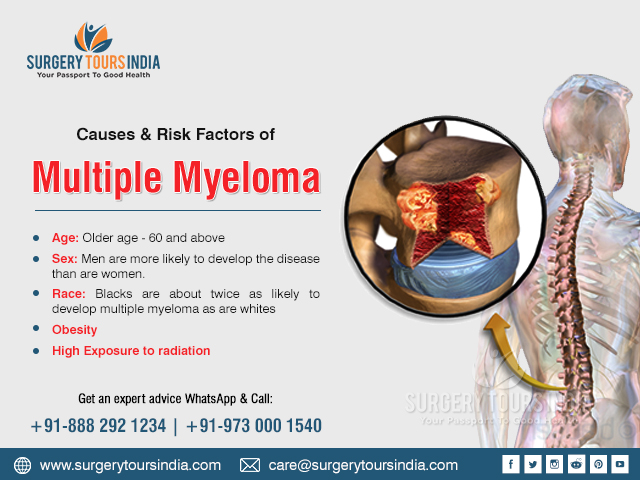
Risk Factors:

There is no exact cause known for the disease. However there are few risk factors associated with increased risk of multiple myeloma, these include:
  • Age factor: More common in elder people.
  • Gender: Males are more likely to get multiple myeloma than female.
  • Family History: If someone is having family history of multiple myeloma, he or she is 4 times more likely to develop multiple myeloma compared to others.
  • Though not proved, but People who have suffered from some kind of injury are also prone to get multiple myeloma.
  • Few other plasma cell diseases like solitary plasmacytoma or Monoclonoal gamopathy of unknown significance are associated with high risk for developing multiple myeloma.


You May Also Like

Bone Marrow Transplant in India
Bone Marrow Transplant in India:
Bone Marrow Transplant (BMT) team associated with Surgery Tours India is globally recognized for expertise in comprehensive specialty treatments for adults & children with Leukemia
Cardiac Ablation
Cardiac Ablation for Heart Rhythm Problems:
A healthy heart is a key to live a quality life. Arrhythmia has turned out to be a common cause of concern these days. 'Arrhythmia' is a scientific term that is used to describe heart 

Chemotherapy for Cancer Treatment  India
Chemotherapy for Cancer Treatment In India:
Cancer is a condition in which body continuously divide or forms large number of cells for no use. This is unstoppable process but it can be controlled with chemotherapy. 


Liver Cancer Treatment
Liver Cancer Treatment:
The liver is one of the most important organs of the body as it is responsible for filtering the blood continuously for converting nutrients into necessary chemicals that are required by the body for various important purposes.

Elbow Replacement Surgery in India
Elbow Replacement Surgery in India:
An elbow replacement surgery is a surgical procedure through which the doctor will try to restore the normal functioning and movement to the elbow, mostly, when it is affected by severe